
AI Integration Expands in Film Production: Reshaping Bollywood’s Creative and Technical Landscape
NovaEchoMedia Editorial
2 min read
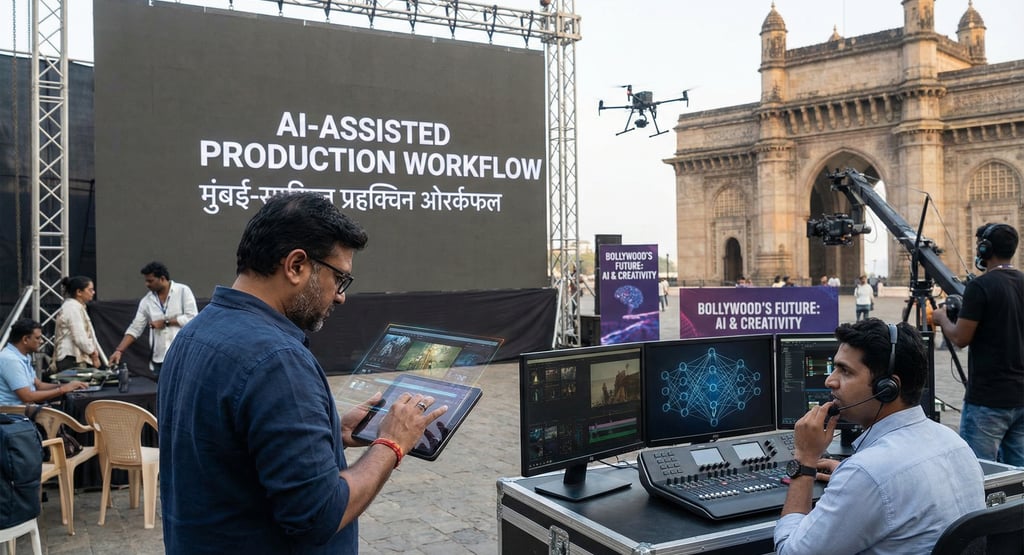
From Experimentation to Implementation
A few years ago, AI tools were primarily experimental. Today, they are integrated into daily production pipelines.
Studios are deploying AI for:
Automated script breakdown and scheduling assistance
Virtual pre-visualization and scene planning
De-aging and facial enhancement
Background extension and crowd replication
Automated rotoscoping
AI-based video upscaling up to 4K and 8K
Digital dust, scratch, and noise removal in restoration
This shift marks a transition from curiosity-driven experimentation to performance-driven implementation.
AI in Pre-Production and Planning
Pre-production has become more data-informed with AI tools analyzing scripts to estimate budgets, optimize schedules, and predict logistical challenges.
AI-assisted pre-visualization tools allow directors and cinematographers to simulate lighting setups, camera angles, and scene composition before stepping onto the set. This reduces production risk and improves resource allocation.
The result is better planning, fewer costly delays, and more informed creative decisions.
On-Set Enhancements and Virtual Production
AI-powered virtual production environments are increasingly being used in combination with LED walls and real-time rendering systems. These tools allow filmmakers to:
Visualize digital environments live on set
Adjust lighting dynamically
Reduce location dependency
Minimize large-scale set construction
By merging AI with real-time engines, production teams gain greater creative flexibility while controlling costs.
Post-Production: Where AI Delivers Maximum Impact
Post-production is currently the strongest area of AI adoption.
Automated Rotoscoping and Masking
AI-driven rotoscoping tools significantly reduce manual frame-by-frame subject isolation time, accelerating VFX workflows.
AI Video Upscaling
Older footage and archival material are being enhanced using AI upscaling techniques that rebuild missing detail rather than merely enlarging frames. This is particularly valuable for remastering legacy films for modern streaming platforms.
Noise Reduction and Image Cleanup
AI models trained to distinguish between grain and unwanted artifacts enable precise dust, scratch, and noise removal while preserving natural texture.
Color Matching and Scene Consistency
AI-assisted grading tools help maintain visual consistency across complex edits, speeding up color correction processes while still requiring human supervision for final creative control.
Film Restoration and Archival Preservation
AI is playing a transformative role in film restoration. Large-scale restoration projects that once required years of manual work can now be processed more efficiently with AI-assisted detection and repair systems.
Key areas include:
Frame stabilization
Flicker correction
Scratch detection and removal
Detail reconstruction
Audio cleanup and enhancement
However, responsible restoration still depends on experienced professionals to prevent over-processing and protect the original cinematic character.
Human Creativity Remains Central
Despite expanding integration, AI does not replace directors, editors, cinematographers, or restoration specialists. It handles repetitive and technical tasks at scale, allowing creative teams to focus on storytelling, aesthetic judgment, and artistic integrity.
The most successful production houses are not those that rely solely on AI, but those that combine automation with expert supervision.
AI accelerates execution. Humans define vision.
Economic and Industry Impact
AI adoption is also influencing budgets and production models. By reducing time-intensive workflows and optimizing resource allocation, AI helps:
Lower post-production timelines
Improve cost efficiency
Increase output scalability
Enhance global competitiveness
For industries like Bollywood, where both large-scale spectacles and mid-budget films coexist, AI provides flexibility across different budget tiers.
Challenges and Ethical Considerations
With expanded AI integration comes new considerations:
Data ownership and licensing
Ethical use of digital likeness and de-aging
Creative transparency
Maintaining originality over automation
The industry is gradually developing frameworks to ensure AI use remains responsible and artistically respectful.
The Road Ahead
AI integration in film production is not a passing trend. It represents a structural shift in how films are planned, produced, enhanced, and preserved.
As Indian cinema continues gaining global recognition, technological sophistication will become increasingly important. AI-assisted workflows, high-resolution mastering, advanced VFX pipelines, and restoration capabilities will define the next decade of cinematic production.
The future of film is not human versus machine.
It is human creativity, powered by intelligent systems.
Connect
Expert post-production for stunning visuals.
Contact
Join Our Newsletter
vikas@novaechomedia.com
+91-79774 48456
© 2025. All rights reserved.