
How AI Is Transforming Post-Production and the Future of the Media Industry
NovaEchoMedia Editorial
5 min read
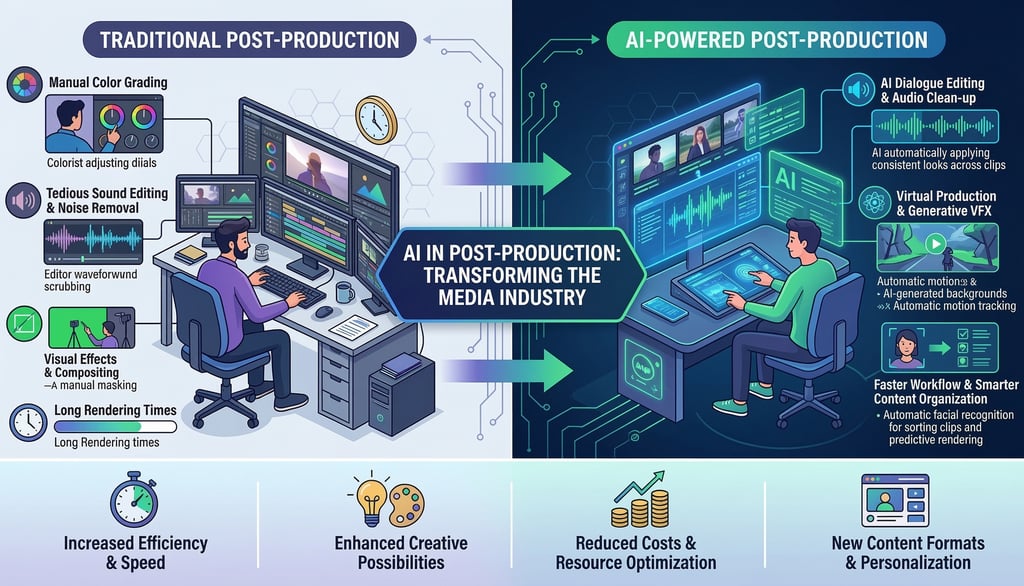
The media industry has always evolved alongside technology. From the transition from silent films to sound, the move from analog film to digital cameras, and the rise of streaming platforms, technological innovation has continually reshaped how content is produced and consumed. Today, another major transformation is underway: the integration of artificial intelligence into post-production and media workflows.
Artificial intelligence is no longer a futuristic concept limited to research labs. It has become a practical tool used by editors, restoration specialists, visual effects artists, and media production teams worldwide. By automating repetitive tasks, improving efficiency, and enhancing image and video quality, AI is rapidly becoming one of the most influential technologies in modern media production.
This article explores how AI is changing post-production workflows, the opportunities it creates for the media industry, and the challenges professionals must consider as the technology continues to evolve.
The Traditional Post-Production Workflow
Before understanding how AI is transforming the industry, it is important to look at how post-production traditionally works.
Post-production is the stage of media creation that takes place after filming. It includes a wide range of processes such as:
Video editing
Color correction and grading
Sound design and mixing
Visual effects (VFX)
Motion graphics
Image and video restoration
Final mastering and distribution preparation
Historically, many of these tasks required meticulous manual work. For example, removing scratches from old film footage often required frame-by-frame cleanup. Similarly, rotoscoping—isolating subjects from backgrounds for visual effects—could take artists days or even weeks to complete.
While these processes produced high-quality results, they were often time-consuming and resource-intensive. This is where AI is beginning to make a significant difference.
AI-Powered Automation in Post-Production
Artificial intelligence excels at analyzing patterns in large datasets. In media production, this capability allows AI tools to examine images, videos, and audio files to detect imperfections, recognize objects, and predict missing visual details.
Many modern editing tools now include AI-powered features designed to automate repetitive tasks. For instance, AI can automatically detect objects within a frame, allowing editors to isolate subjects without manually tracing them. Similarly, AI tools can identify and remove noise from audio recordings or stabilize shaky footage with minimal human intervention.
These technologies do not replace professional editors or artists, but they dramatically speed up workflows. Instead of spending hours performing repetitive tasks, professionals can focus on the creative aspects of production, such as storytelling, visual style, and pacing.
AI in Video Upscaling and Image Enhancement
One of the most widely used AI applications in the media industry is video and image upscaling.
Older video content was often produced in lower resolutions, such as standard definition (SD) or early high definition (HD). With modern displays supporting 4K and even 8K resolutions, these older videos may appear blurry or pixelated on newer screens.
AI-based upscaling technology solves this problem by reconstructing missing detail rather than simply enlarging the image. By analyzing patterns and textures within the original footage, AI can generate new pixels that create a sharper and more detailed image.
This technology is particularly valuable for:
Film studios restoring classic movies
Television networks upgrading archival footage
Streaming platforms preparing legacy content for modern audiences
Content creators improving older recordings for re-release
As a result, many media companies are now investing in AI-powered enhancement tools to extend the life of their existing content libraries.
Film and Photo Restoration in the Digital Age
Another area where AI is making a significant impact is film and photo restoration.
Old photographs and film reels often suffer from various types of damage, including scratches, dust, fading colors, and chemical degradation. Traditionally, restoration specialists had to manually repair these issues frame by frame or pixel by pixel.
AI has introduced new methods that can automatically detect and repair many of these imperfections. By comparing neighboring pixels and analyzing image patterns, AI tools can reconstruct damaged areas while preserving the original look of the media.
For example, AI can:
Remove scratches and dust from old film footage
Restore faded colors in vintage photographs
Stabilize shaky or degraded video
Rebuild missing image details
These capabilities are helping archives, museums, and studios preserve valuable cultural content that might otherwise be lost to time.
Improving Efficiency for Media Production Teams
Beyond restoration and enhancement, AI is also improving the overall efficiency of production teams.
Media companies today must produce more content than ever before. Streaming platforms release new shows and films every week, social media platforms demand constant updates, and online audiences expect high production quality.
AI tools help production teams keep up with this demand by reducing the time required for repetitive editing tasks. Automated tagging systems can organize large libraries of video footage, making it easier for editors to locate specific scenes. AI transcription tools can convert speech into text, allowing editors to quickly search through dialogue and interviews.
These improvements save time and reduce production costs while allowing creative teams to focus on developing compelling stories and visuals.
The Role of Human Creativity
Despite the rapid growth of AI technology, human creativity remains at the center of the media industry.
AI can analyze data and automate processes, but it cannot fully replace the artistic judgment required for storytelling, visual composition, and emotional impact. Editors decide how scenes should flow, colorists determine the mood of a film through color grading, and directors shape the overall vision of a project.
AI tools function best when used as assistants rather than replacements. They provide efficiency and technical support while human professionals guide the creative direction.
This collaboration between technology and creativity is likely to define the future of media production.
Challenges and Ethical Considerations
While AI offers many benefits, its rapid adoption also raises important challenges and ethical questions.
One concern is the potential misuse of AI-generated media. Technologies capable of altering images and videos can be used to create misleading or manipulated content. This has led to discussions about digital authenticity and the need for responsible use of AI tools.
Another challenge is ensuring that AI does not lead to excessive automation at the expense of creative professionals. While automation improves efficiency, it is important that the industry continues to value and support skilled artists and technicians.
Finally, there is the issue of data privacy and copyright. AI systems often require large datasets for training, which can raise questions about ownership and intellectual property rights.
Addressing these challenges will require collaboration between technology companies, media organizations, and policymakers.
The Future of AI in the Media Industry
Looking ahead, AI is expected to play an even larger role in media production.
Future developments may include more advanced video enhancement tools, real-time visual effects generation, automated editing assistants, and improved media restoration techniques. As computing power increases and machine learning models become more sophisticated, the capabilities of AI will continue to expand.
However, the most successful media companies will be those that balance technological innovation with human creativity. AI can enhance workflows and unlock new possibilities, but the core of storytelling will always depend on human imagination and artistic vision.
Conclusion
Artificial intelligence is transforming post-production and reshaping the media industry in profound ways. From automating repetitive tasks to restoring historical footage and enhancing video quality, AI is providing powerful tools that help professionals work faster and more efficiently.
At the same time, the role of human creativity remains essential. The future of media production will likely be defined by collaboration between technology and skilled professionals who understand how to use these tools effectively.
As AI continues to evolve, it will not replace the art of storytelling. Instead, it will expand the possibilities for how stories can be created, preserved, and shared with audiences around the world.
Connect
Expert post-production for stunning visuals.
Contact
Join Our Newsletter
vikas@novaechomedia.com
+91-79774 48456
© 2025. All rights reserved.