
Post-Production Studios See Growing Demand: The New Power Center of Indian Cinema
NovaEchoMedia Editorial
2 min read

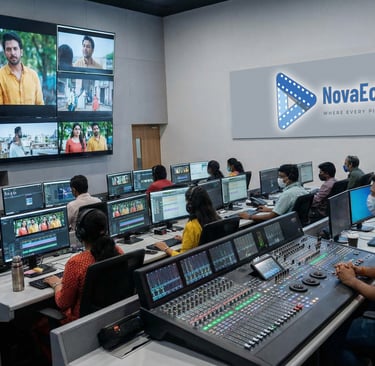
In 2026, post-production is no longer the final step in filmmaking. It has become one of the most critical pillars of the production ecosystem. Across Mumbai, Hyderabad, and emerging creative hubs, post-production studios are experiencing a steady rise in demand driven by OTT expansion, global distribution standards, restoration projects, and high-resolution mastering requirements.
What was once considered a support function is now a strategic value driver.
OTT Expansion Is Raising Technical Standards
The rapid growth of streaming platforms has significantly influenced post-production demand. OTT platforms require strict technical delivery standards, including:
4K and 8K mastering
HDR color grading
Dolby Atmos audio mixing
Broadcast-compliant formatting
Consistent color pipelines
These specifications have elevated expectations across the board. Content that may have previously been optimized for theatrical screens alone must now meet global streaming benchmarks.
As a result, production houses are increasingly partnering with advanced post-production studios early in the filmmaking process.
The Rise of High-Resolution Workflows
The demand for 4K and 8K video delivery is growing steadily. High-resolution displays and premium streaming experiences have shifted audience expectations toward sharper visuals and enhanced detail.
Post-production facilities are investing in:
High-performance rendering systems
AI-assisted video upscaling
Advanced color science calibration
Precision monitoring environments
Upscaling older content for modern platforms has also become a significant segment, particularly for studios looking to monetize archival libraries.
Film Restoration and Archival Preservation
Another major driver of demand is large-scale film restoration. As classic films are re-released digitally or licensed internationally, restoration has become a commercial priority.
Post-production studios are handling:
Dust and scratch removal
Frame stabilization
Flicker correction
Color reconstruction
Audio enhancement
AI-assisted tools have accelerated restoration timelines, but professional supervision remains essential to preserve original cinematic texture and authenticity.
Archival preservation is no longer optional. It is a strategic investment in long-term content value.
Growth in VFX and Compositing Workflows
Visual effects integration is expanding beyond big-budget spectacles. Mid-budget films and web series now incorporate advanced compositing, digital environments, and CGI enhancement.
Demand has increased for:
Automated rotoscoping
Motion tracking
Digital set extensions
Crowd replication
Seamless compositing
Post-production studios are evolving into hybrid creative-technical hubs capable of managing both artistic and technical complexity.
Data-Driven Delivery and Versioning
With content being distributed across multiple platforms and territories, version management has become a critical post-production responsibility.
Studios now handle:
Multiple language versions
Regional censorship edits
Platform-specific deliverables
Trailer and promotional asset mastering
This operational complexity has elevated post-production from finishing service to distribution partner.
Infrastructure Investment and Talent Expansion
To meet rising demand, post-production houses are upgrading infrastructure and expanding skilled teams. Investments include:
AI-enhanced editing suites
Real-time collaboration systems
Secure data storage environments
Advanced calibration tools
Skilled colorists, restoration specialists, VFX supervisors, and mastering engineers are increasingly central to production success.
Why Post-Production Is Now a Strategic Advantage
In today’s media landscape, the perceived quality of a film often depends on finishing precision. Even strong storytelling can be undermined by inconsistent grading, poor sound mixing, or technical delivery issues.
Studios that prioritize post-production excellence gain:
Competitive advantage in global markets
Higher licensing potential
Better audience retention
Stronger archival longevity
The value of content no longer ends at release. It extends through remastering, restoration, and repurposing cycles.
The Road Ahead
The steady rise in demand for post-production services signals a structural shift within Indian cinema. As production models diversify and global competition intensifies, finishing precision will become even more important.
Post-production is no longer the back end of filmmaking.
It is the engine that defines final quality, global readiness, and long-term asset value.
For the industry, this growth reflects more than operational expansion. It represents maturation where technical excellence stands alongside creative vision as a defining force in Indian cinema’s evolution.
Connect
Expert post-production for stunning visuals.
Contact
Join Our Newsletter
vikas@novaechomedia.com
+91-79774 48456
© 2025. All rights reserved.